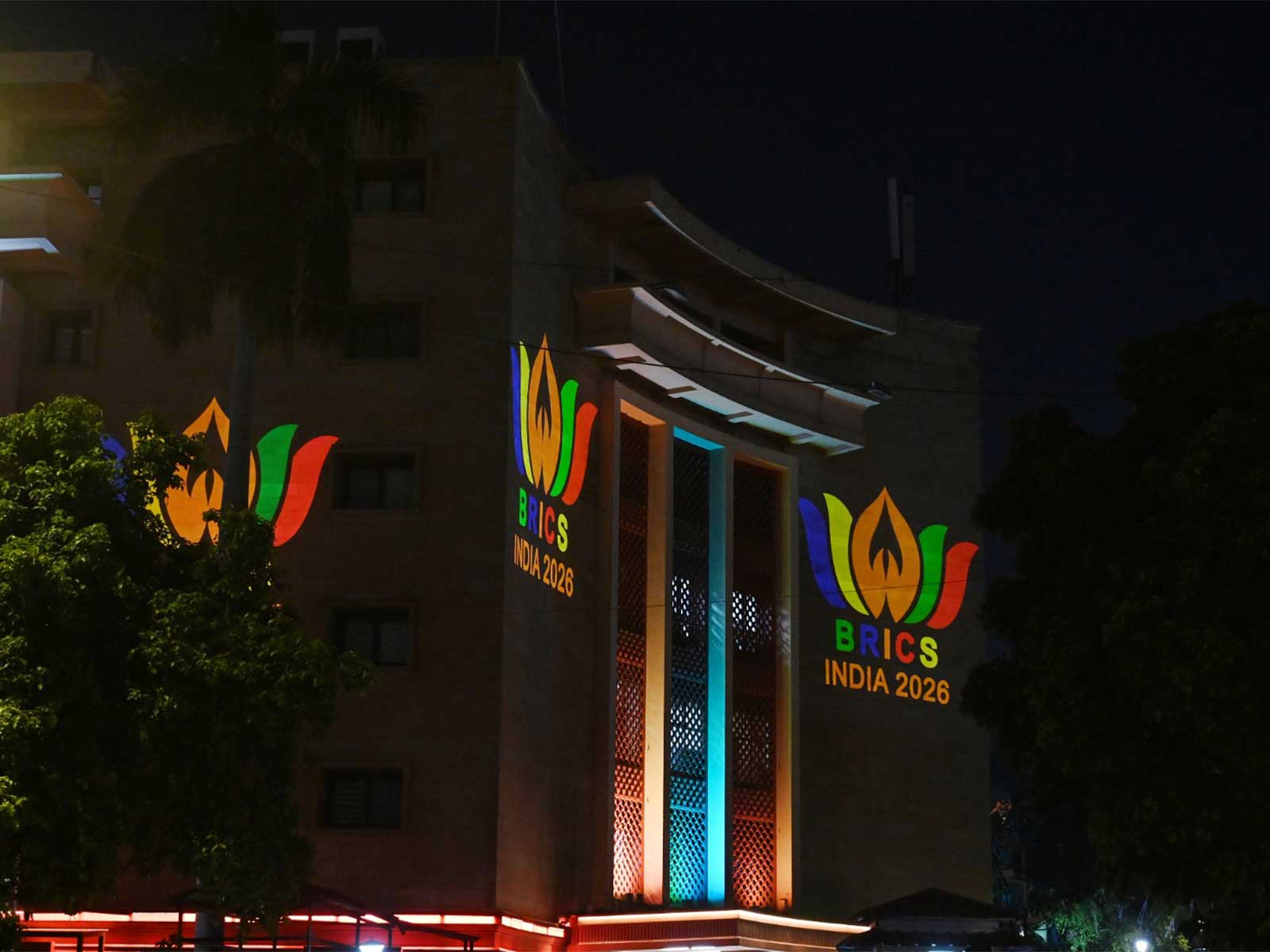
New Delhi [India], September 9 (ANI): Twenty years after its formation, BRICS has acquired enormous economic weight and a growing institutional footprint. Twenty years after the BRIC grouping took shape, BRICS has become one of the clearest institutional expressions of the changing global economy.
What began as an acronym coined by Goldman Sachs to describe four emerging economies — Brazil, Russia, India and China — has evolved into a broader grouping with considerable economic and geopolitical weight. Its expansion has also changed the nature of the organisation: from an informal economic conversation among emerging powers into a platform that increasingly addresses trade, finance, development, technology, supply chains and the architecture of global governance.
The grouping's economic weight is undeniable. BRICS economies accounted for almost 40 per cent of global GDP on a purchasing power parity basis in 2024, according to IMF data, compared with approximately 29 per cent for the G7. Yet intra-BRICS trade remains relatively limited in relation to that economic size. United Nations Trade and Development (UNCTAD) estimates that trade among BRICS members rose more than 13-fold, from USD 84 billion in 2003 to around USD 1.17 trillion in 2024. Despite that increase, intra-BRICS trade still represents only around 5 per cent of global trade.
RN Bhaskar, senior journalist, educationist and researcher, describes its origins in stark terms.
“BRICS was an artificial construct of Goldman Sachs," Bhaskar said.
But the acronym acquired a political life beyond the intentions of its creators. Bhaskar credits Russia with recognising that potential early.
“It was Russia that had the vision to convert this into a platform," he noted.
That platform gradually acquired institutional form. South Africa joined in 2010, followed by the more recent expansion that brought in Egypt, Ethiopia, Iran, Indonesia, the UAE and Saudi Arabia. The expansion reflected something larger than the institutional growth of BRICS. The economic centre of gravity itself was moving.
Emerging economies were becoming increasingly important contributors to global growth, trade, manufacturing, commodities and investment, while their representation in institutions such as the IMF and World Bank remained shaped by an earlier distribution of economic power. For Bhaskar, this is where BRICS acquired its wider significance. RN Bhaskar argues that India's early participation was also connected to its long-standing engagement with the Global South and its interest in playing a leadership role among developing countries.
The grouping therefore evolved alongside a broader demand: economic power should translate into greater political and institutional representation. The most significant transformation associated with BRICS is not necessarily the creation of an alternative financial system. It is the changing geography of global production and trade.
UNCTAD estimates that BRICS members' global merchandise exports increased from nearly USD 1 trillion in 2003 to around USD 6 trillion in 2024. Their share of global exports doubled from approximately 12 per cent to 24 per cent over the same period. That shift has occurred alongside the extraordinary rise of China, the growing weight of India and the continued importance of Brazil, Russia, the Gulf economies and other emerging markets.
China remains the central trading power. UNCTAD's 2026 study finds that China is the largest exporter and importer within intra-BRICS trade, while several other members remain heavily dependent on BRICS markets for their exports and imports. Seven members also rely heavily on primary products for their exports to other BRICS economies.
Prof. Manoj Pant, economist, visiting faculty at Shiv Nadar University and former vice chancellor of the Indian Institute of Foreign Trade, makes this distinction central to his assessment.
“China is central to the world trade," he said.
For Pant, the growth in intra-BRICS trade is real, but it does not necessarily indicate the emergence of a deeply integrated economic bloc. A significant part of that trade remains connected to China's position at the centre of global supply chains.
That does not diminish the importance of the grouping. It changes how its economic achievements should be measured. The growth of intra-BRICS trade is nevertheless substantial. According to the Ministry of Commerce, merchandise trade among BRICS members increased from USD 84 billion in 2003 to USD 1.17 trillion in 2024 — a 13-fold increase. Yet it remains only about 5 per cent of global trade, highlighting the room for further expansion.
Pant makes essentially the same point from a different angle. He notes that while intra-BRICS trade has increased dramatically compared with the early years of the grouping, it remains a relatively small component of global commerce.
Investment, in his view, is a more meaningful indicator of whether businesses genuinely see another member economy as part of their long-term economic ecosystem.
Pant argues that the absence of deeper institutional, telecommunications and business links — particularly among smaller industries — limits the development of a truly integrated BRICS market. In other words, BRICS has created more trade between economies than integration between their economic systems.
Countries can trade heavily with each other without building the corporate, financial and supply-chain relationships that make their economies structurally dependent on one another. Pant argues that this remains one of BRICS' fundamental weaknesses.
“There are no institutional links among small-scale industries of BRICS countries," he explained.
China's enormous manufacturing base, export capacity and trading relationships provide the grouping with an economic anchor. For China, BRICS offers another platform through which it can deepen relationships across the Global South. For commodity exporters, it provides access to a major market. For India, Brazil and others, it offers a mechanism for diversification and a larger collective voice.
UNCTAD's BRICS Investment Report in 2023 nevertheless shows that the original BRICS economies have become substantially more important sources and destinations of global investment, with FDI inflows into the original five more than quadrupling between 2001 and 2021. The challenge is to translate that broader investment weight into more investment among BRICS members themselves.
BRICS' most concrete contribution to the global economic architecture has arguably been the creation of the New Development Bank. Established in 2014, the NDB created a development-financing institution outside the traditional Bretton Woods framework, with its founding membership centred on the original BRICS economies. The institution has subsequently expanded its membership and increased its focus on infrastructure, sustainable development and local-currency financing.
At the 2025 BRICS Summit in Rio, leaders backed greater local-currency financing and diversification of funding sources while describing the NDB as an important institution for the Global South.
The debate over the dollar has become one of the most politically prominent elements of BRICS. Bhaskar believes the use of sanctions, financial restrictions and the dollar-based financial system as instruments of geopolitical pressure has strengthened the case for countries to seek alternatives.
"US sanctions are not working because of BRICS. Despite US sanctions, it is because of BRICS that this [investment] platform has been working," RN Bhaskar said.
New Delhi has consistently supported greater representation for emerging economies in global institutions while remaining deeply connected to Western markets, investment and technology. Its approach under the 2026 BRICS chairship has been particularly focused on practical economic cooperation rather than a wholesale confrontation with the existing system.
At the 16th BRICS Trade Ministers' Meeting in Jaipur, India pushed for a WTO-centred multilateral trading system, resilient and diversified global value chains, MSME internationalisation, trade finance and greater cooperation in digitally delivered services. The meeting also advanced the "Strategy for BRICS Economic Partnership 2030", covering areas including trade, investment, services, the digital economy, innovation, financial cooperation and sustainable development.
The grouping's most consequential contribution may ultimately be political rather than economic. BRICS has helped turn the demand for greater Global South representation into an organised institutional agenda. The 2025 Rio Declaration called for reform of the governance structures of the Bretton Woods institutions to reflect the increased weight of emerging-market and developing economies. It also called for greater voice and representation for developing countries in the IMF and World Bank. At the same time, BRICS reaffirmed support for the WTO-centred multilateral trading system.
BRICS is not necessarily advocating the destruction of the existing global economic architecture. Much of its agenda is aimed at changing the distribution of influence within that architecture.
RN Bhaskar, sees the shift as part of a broader restructuring of global economic and financial flows. He argues that growing reliance on alternative channels is already visible in the movement of financial discussions and contracts away from traditional Western centres.
“Increasingly, more countries are now willing to enter transactions in non-dollar currencies,” he said.
The challenge for BRICS over the next decade is therefore not proving that its economies are large. That has already been established. The challenge is building the economic connections that its size would suggest should exist. BRICS has undoubtedly contributed to the emergence of a more multipolar global economy. It has increased the visibility and bargaining power of emerging economies, created new institutions such as the NDB, expanded South-South trade and challenged the assumption that global economic governance can remain centred exclusively on Western powers.
BRICS has not replaced the Western-led global economic order. It has, however, made that order less exclusively Western. Its economic weight is already large enough to influence global trade and investment patterns. Its institutions are beginning to provide alternatives at the margins. Its political platform has given the Global South greater collective visibility. The unfinished task is converting that collective weight into deeper economic integration.
At 20, BRICS has therefore changed the global economic conversation faster than it has changed the global economic architecture. And the next twenty years will determine whether it remains a powerful platform for a multipolar world — or develops into the integrated economic force that its numbers increasingly suggest it could become. (ANI)
BRICS Summit 2026: How the grouping is reshaping the global economic order