Varanasi (Uttar Pradesh) [India], November 1 (ANI): Varanasi, Uttar Pradesh, will host the three-day World Symposium on Ancient Wisdom for Modern Challenges from November 2 to 4.
Several leading scholars, philosophers, business leaders and policy experts from India and across the world are expected to participate in the gathering. The symposium aims to explore how India's ancient philosophical, spiritual and cultural traditions can offer insights into addressing contemporary global challenges. Special focus will be placed on Hinduism, Buddhism, and Jainism, the participating scholars said.
Discussions will revolve around four key themes: peace and dialogue among civilisations; sustainable development and planetary stewardship ethics and governance; and inner development and human well-being
As part of the programme, participants will also visit important religious and historical sites in Varanasi and Sarnath where Lord Buddha delivered his first sermon.
The central message of the symposium is rooted in the Indian philosophy of 'Vasudhaiva Kutumbakam', which promotes mutual understanding, peace and cooperation among civilisations.
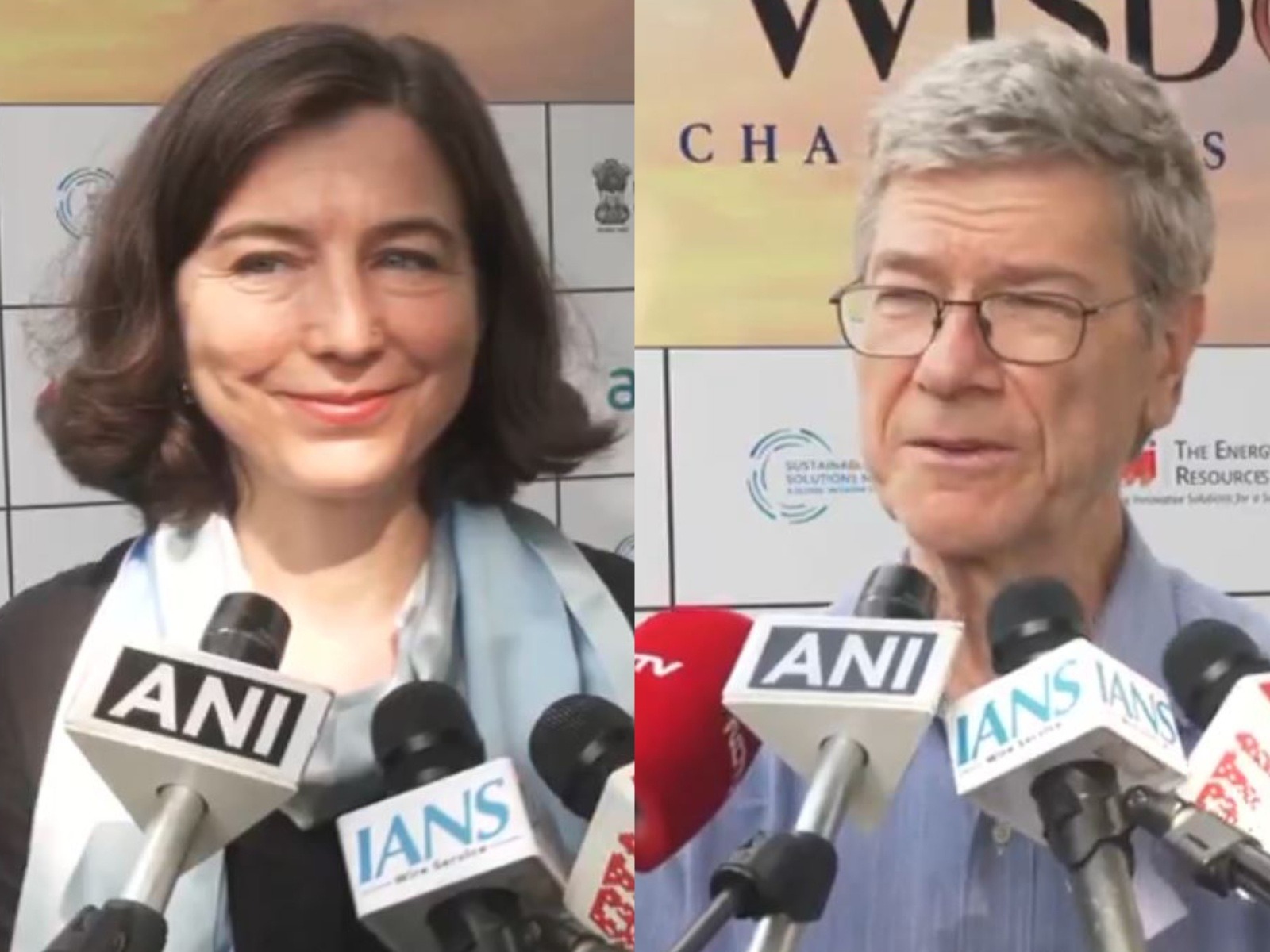
President of the UN Sustainable Development Solutions Network, Jeffrey Sachs, said that the global society needs to be on a “common path of harmony and diversity, with shared goals of prosperity, social justice, environmental sustainability and peace.”
Speaking to reporters in Varanasi, he said, “I'm really thrilled to be co-hosting this World Symposium on Ancient Wisdom for Modern Challenges... We have profound global challenges in which every segment of society has to do their part to find peace, cooperation and a shared way forward. We need to be on a common path of harmony and diversity, with shared goals of prosperity, social justice, environmental sustainability and peace."
Describing the role of the United Nations, he added, “Part of the goal of these symposia is to bring together philosophers and practitioners, business leaders, politicians, policy makers, and United Nations officials. So when we have these symposia, we share the outcomes very widely and discuss them. For example, we'll have new United Nations leadership being selected in the coming weeks. In my role as president of the UN Sustainable Development Solutions Network, I will brief the new Secretary-General on this meeting and on the fact that we've had a global dialogue on these issues. We are also very much in touch with UN organisations, the science of civilisations, for example, and in partnership with them to make sure that we have peace and dialogue as our foundation for what the world needs right now.”
Associate Professor of Philosophy, Utrecht University, Netherlands, Chiara Robbiano said that ancient wisdom can provide frameworks and concepts to rethink contemporary predicaments.
Robbiano stated, “The goal is to learn how to have dialogue across differences and bring our diverse cultures together... Ancient wisdom can give us frameworks and concepts that we can use to rethink contemporary predicaments or contemporary opportunities. So we need to think about these things, not just do them. That's why the humanities can really contribute to it. And and from different traditions is very important to exchange these concepts that might make us avoid blind spots if we don't if we only reason from our own tradition."
Riccardo Pozzo, a Professor from the University of Rome, described the green and digital transitions as the main issues of present times.
He said, “We had a World Congress in Athens in 2013, another in Beijing in 2018, and one in Rome. The dialogue connecting Aristotle, Confucius, Buddha and Islam began during these congresses, starting with philosophy and extending into civil society, politics and geopolitics. The green and digital transitions are the main issues of these decades. Ancient wisdom, whether Buddhist, Confucian, Taoist, Christian or Islamic, can help set forth meaningful advancement."
He added that they accepted the invitation to Varanasi, which he described as a holy city, as the city hosted the G20 Development Ministers’ Meeting under India’s presidency in 2023.
Pozzo told reporters, “Varanasi was the seat of the G20 of 2023 for sustainable development, and actually we considered that when we met in Rome in the Vatican a few weeks later. We considered the role of India in achieving sustainable development. So, Varanasi is a holy city. It's the vital core of India, and we are very happy to be here. That's the reason we have accepted the kind invitation of the Ministry of Culture of India to come here.”
Meanwhile, Professor of Philosophy at Addis Ababa University, Ethiopia, Workineh Kelbessa emphasised indigenous knowledge from Africa.
He said, “I've been working on indigenous environmental knowledge in Africa. Indigenous knowledge was neglected and devalued, but after studying many African societies, including ethnic groups in Ethiopia, I confirmed that this was wrong. Indigenous knowledge is based on practical experience as well as borrowed and adapted knowledge. It is important to approach it cautiously and use its positive contributions to address environmental and social issues.” (ANI)
"Common path of harmony, diversity": Varanasi to host Symposium on Ancient Wisdom for Modern Challenges on Nov 2-4