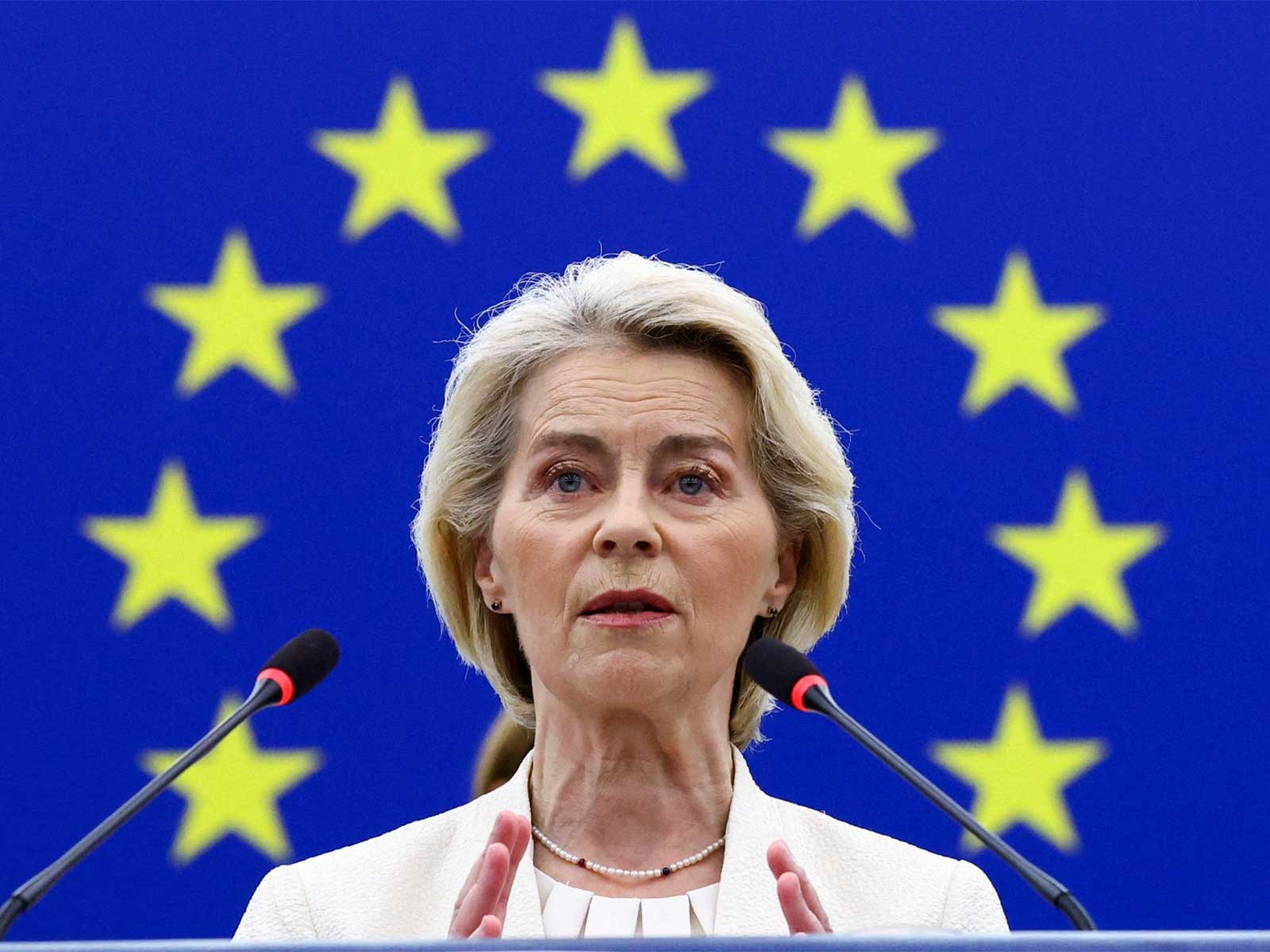
Strasbourg [France], September 16 (ANI): European Commission President Ursula von der Leyen on Wednesday announced that the European Union will propose the EU KIDS Act, introducing age-based restrictions and stronger safeguards for children using social media platforms. The proposal details stricter restrictions for younger children, with proposals for platforms requiring "safe design" for teenagers too.
Addressing the European Parliament during her 2026 State of the Union speech, von der Leyen said the Commission would adopt a “gradual and differentiated approach”, with tailored protection levels based on age.
“No social media under the age of 13. No personal account under the age of 15,” she said.
Under the proposed framework, children aged 13 to 15 would only be allowed to use “mini accounts” set up and supervised by parents or guardians, with limited features and a one-hour-a-day time restriction.
For those aged between 15 and 18, platforms would be required to ensure “safe design”, she said.
Von der Leyen said the EU could not accept addictive features on social media platforms or children being exposed to increasingly extreme content.
“We do not have to accept that girls have their photos used for AI-generated sexualised images,” she said.
She said the proposed legislation would seek to shift the responsibility onto technology platforms to demonstrate that their services are safe for minors.
“We are reversing the burden of proof. Platforms will have to prove to us that they are safe,” von der Leyen said.
“Because it is not about our minors accessing social media. It is about when and how do we allow social media to access minors,” she added.
Emphasising the EU's regulatory authority over technology companies, von der Leyen said, “Europe has the power to act. It is we who decide our rules, not big tech.”
The Commission President also announced plans for a broader Digital Fairness Act, saying that concerns around addictive digital design extend beyond children.
“Addictive design, for example, is harming everyone. This is why we need a wider framework, the Digital Fairness Act. We will propose it in autumn,” she said.
Meanwhile, on the front of Artificial Intelligence (AI), she underlined the need to use AI in a constructive manner and said, “AI is fast becoming a foundational layer for our economy and security. Europe's stance is clear. We want to make the most of AI to improve our society, our quality of life and our productivity. I am an optimist that AI has the potential to benefit humanity – if we get it right.”
The EU Chief urged a balancing act to address the new technology and said that the bloc will step up together with like-minded partners like “Canada, the United Kingdom and others” to team up on model evaluation, verification, early warning, AI security, among other areas, and invited the main frontier labs for a discussion on how we can support ongoing industry efforts to pace the frontier.
“We want AI. We want AI to create more value, more responsibly. And at a lower cost and with less energy consumption. But above all, we want AI with human agency. This is the essence of the European way,” she underlined in her remarks.
President Ursula von der Leyen also called for the creation of an “Emergency Security Protocol” for the European Union, describing it as “Europe’s own Article 4” to coordinate a collective response to hybrid security threats.
“Europe's belief in cooperation has always been driven by peace. It is our raison d'être. Today, that peace is threatened,” she said.
Referring to incidents reported in Denmark, Lithuania and Poland over the past week, as well as an attempted drone attack in Leipzig, von der Leyen said the latter involved “military-grade material” and was carried out by “Russian operatives on European soil”.
“An attack not only on one Member State – but against all of our Union. And, Honourable Members, we will not allow it,” she said.
Von der Leyen said Europe’s preparedness must rise in line with the growing threat level, arguing that the bloc’s existing institutions and decision-making mechanisms had been designed for a different security environment.
“This is why I will propose, together with the HR/VP, a new European security strategy,” she said.
She said the EU needed its own “counter-hybrid playbook” and an agreed mechanism to respond to incidents that fall below the threshold of armed aggression but nevertheless threaten national security.
“I believe it is time for Europe's own Article 4 – or an Emergency Security Protocol,” von der Leyen said.
Von der Leyen also proposed advancing plans for a European Security Council, involving partners including Canada, Norway, Ukraine and the United Kingdom.
“For a long time, we have discussed a leaders' format focused on the security of our continent,” she said, adding that the scale and nature of current risks made such a mechanism “even more urgent now”.
“This is why we will set out our ideas to make a European Security Council a reality,” she said.
In her wide-ranging remarks, von der Leyen also invited Canada to become the European Union's first "associate member", signalling a push by Brussels and Ottawa to deepen economic and strategic ties amid growing uncertainty in transatlantic trade relations. (ANI)
EU looks to curb digital addiction, ban social media for under-13, expand military cooperation with "European Security Protocol"