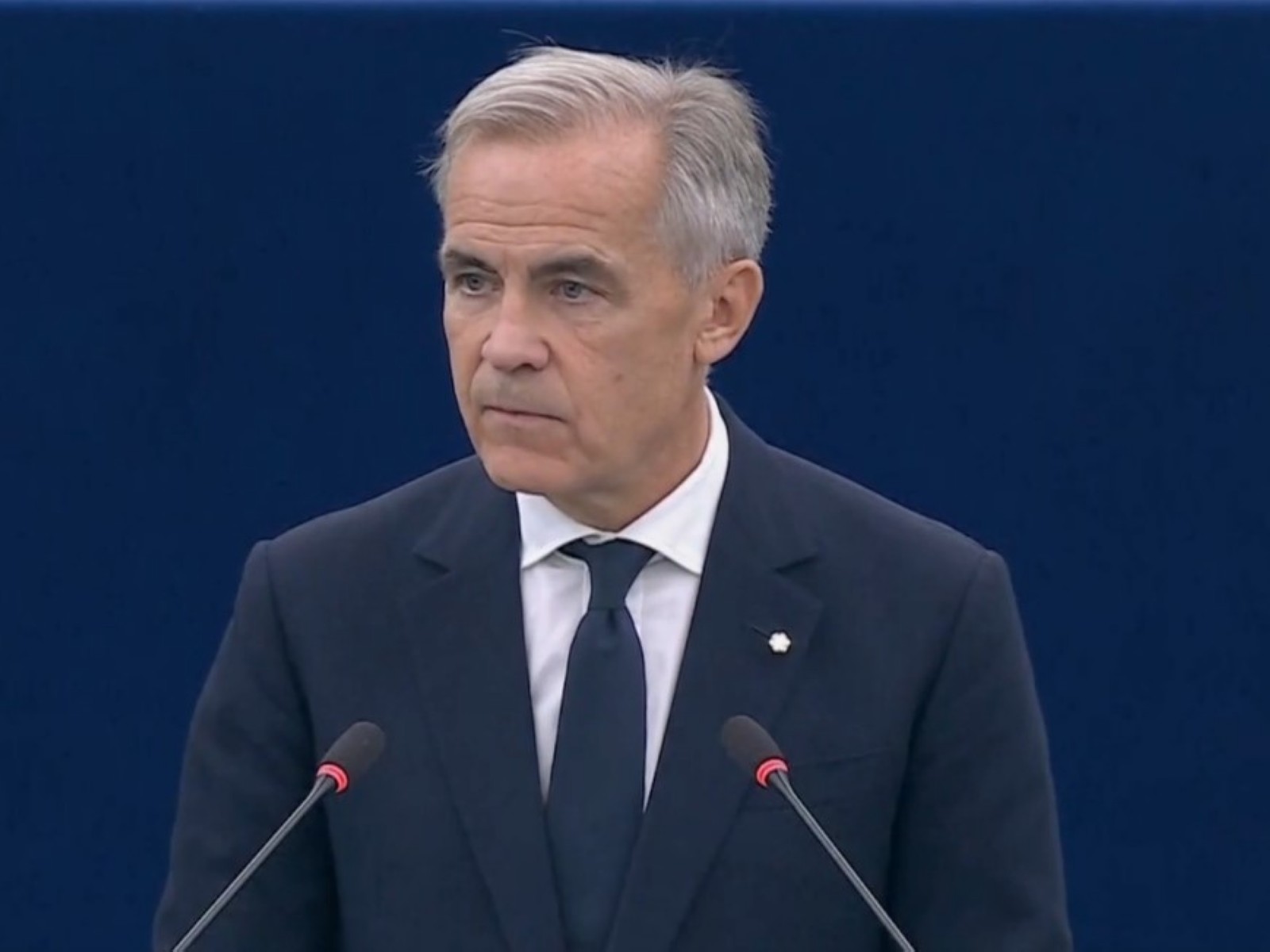
Strasbourg [France], September 17 (ANI): Canadian Prime Minister Mark Carney on Thursday (local time) delivered a landmark address to the European Parliament, warmly welcoming European Commission President Ursula von der Leyen’s historic proposal for Canada to become the European Union’s very first Associate Member.
Addressing lawmakers in Strasbourg a day after von der Leyen pitched the groundbreaking initiative during her State of the Union address, Carney embraced the vision of a transformed transatlantic bond.
Welcoming the initiative, Carney described the partnership between Canada and the EU as a proactive model for global democratic governance. He characterised it as a resilient alliance dedicated to upholding international law and ensuring its agenda is not dictated by outside forces.
"A Canada-EU alliance would create a beacon for other democracies, an alliance not defined by what we oppose, but about what we are for: freedom, solidarity, prosperity, sustainability," the Canadian PM said.
"An alliance that builds resilience for what it allows us to do; for our citizens and our citizens to do for themselves; an alliance strong enough so that no one can dictate our choices, an alliance open enough that others can join, an alliance principled enough that our strength reinforces international law rather than seeks to replace it," he added.
Beyond trade, defence capabilities, and raw economic leverage, Carney placed significant emphasis on social integration and youth mobility, advocating for seamless transatlantic opportunities.
"An alliance for the future is a unique, positive approach that we will define together, building on our common strengths and based on our shared values," he declared. "We should deepen our people-to-people ties, allowing our youth to work, study, and live where they want on either side of the Atlantic."
After von der Leyen proposed moving beyond the existing Comprehensive Economic and Trade Agreement, or CETA, between Canada and the EU towards a broader strategic partnership, Carney thanked the EU leadership for "our Strategic Partnership Agreement struck last June," noting that they are "developing that and deepening it."
He noted that "yesterday, President von der Leyen spoke of moving beyond CETA to an alliance for the future, opening the door to Canada to become the European Union's first associate member," framing the offer as a pivotal moment for democratic nations seeking shared stability.
Regarding the European Commission President's remarks about "a new European corporation on critical raw materials," he highlighted that "Canada has deposits of over 34 critical minerals, and we are among the top producers of the 10 most essential for the energy transition."
"Our alliance can help fill Europe's need for reliable supply, Canada's desire for advanced processing capabilities, and our common objective to complete value chains in the transition and our defence," he emphasised.
Furthermore, Carney drew a sharp line between strategic defence and aggressive geopolitics, clarifying that Ottawa and Brussels are not seeking to create a confrontational geopolitical bloc.
"I also want to be precise about what I am not proposing. I'm not proposing a third bloc in order to become a great power rival only with better manners," Carney affirmed.
"We do not seek power to dominate others. On the contrary, we are pursuing resilience so no one, no one can control our open markets, impair our sovereignty, threaten our territorial integrity, or undermine our freedoms, our democracies, our rule of law," he added.
Firmly rejecting the notion that closer cooperation equates to a surrender of independence, Carney emphasised that the initiative is designed to defend national self-determination against external pressures.
"Deepening and widening our relationship will strengthen our sovereignty, improve affordability and opportunity and security for our citizens, while safeguarding our ability to live our lives as we choose," Carney stated.
The Prime Minister stressed that the proposed partnership is rooted in genuine autonomy rather than transactional self-sufficiency.
"The economics of this are clear. The leverage of the powerful in an exploitative relationship collapses well before complete independence is achieved, because diversity confers advantage. The objective is not self-sufficiency; it's collective resilience. It's this mutual advantage that's at the core of the case for a deeper partnership between Canada and Europe," he stated.
He added that true national strength depends directly on the capacity to withstand external global shocks:
"This is about sovereignty. Our ability to live as we wish. It's about the freedoms we must fight for every day. Because sovereignty requires resilience, the ability to withstand shocks. Canada and Europe are each strong. Europe and Canada are stronger together."
Carney reminded lawmakers that the foundation connecting Canada and Europe extends far beyond commercial agreements:
"The depth of our bonds, those which unite us, cannot be measured by trade or what is written in treaties alone; our bonds are deeply rooted in our lands."
"We are not fair-weather allies. We do not pursue zero-sum deals. Our commitment to the rule of law and our unyielding defence of human dignity, individual freedom, and democracy share the same deep roots, the same unwavering dedication."
Likening the current era of geopolitical fragmentation, weaponised trade, and economic instability to a gathering storm, Carney called for structural unity.
"We are bound by an affinity, elective, chosen, renewed, and stronger for being so. Today, our societies are being battered by new storms," Carney observed. "A single tree will come down in it. A forest will not."
He closed by invoking a broader vision of economic justice and environmental responsibility:
"We hold common values for which we have always fought, and in whose defence we must always remain vigilant. We believe that a strong economy is not an end in itself, but a means to a just society. We are committed stewards of our natural heritage."
European Commission President Ursula von der Leyen on Wednesday invited Canada to become the European Union's first "associate member", signalling a push by Brussels and Ottawa to deepen economic and strategic ties amid growing uncertainty in transatlantic trade relations.
"I invite Canada to be the first associate member of the EU," von der Leyen said during her State of the Union speech here.
Canada is not eligible for full EU membership under the bloc's treaties, which restrict membership to European states.
Against that backdrop, the proposal for an "associate member" represents a possible new framework for closer cooperation between Canada and the 27-member bloc.
Following her remarks, Canadian Prime Minister Mark Carney formally applied for Ottawa's membership to join the Joint Expeditionary Force (JEF), a defence coalition of 10 Northern European NATO nations.
According to a statement issued by the Office of the Prime Minister of Canada on Wednesday following Carney's talks with UK Prime Minister Andy Burnham in Liverpool, the two leaders discussed strengthening their defence and security partnership, with Carney announcing Ottawa's formal application to join the JEF and welcoming the UK's support for Canada's participation.
"Prime Minister Carney announced that Canada has formally applied to join the Joint Expeditionary Force and welcomed the UK’s support for Canada’s participation in this important initiative," the statement read.
The Canadian and European leaders are also due to meet later in October at a summit in Montreal, where issues including trade, defence, energy, critical minerals, technology and Arctic cooperation are expected to feature prominently.
The proposal comes as Canada and the EU seek to strengthen economic resilience amid heightened uncertainty in global trade, including recent tensions between Ottawa and Washington under US President Donald Trump's trade policies. (ANI)
"Europe and Canada are stronger together": Mark Carney welcomes historic offer for Ottawa to become first "Associate Member"