PNN
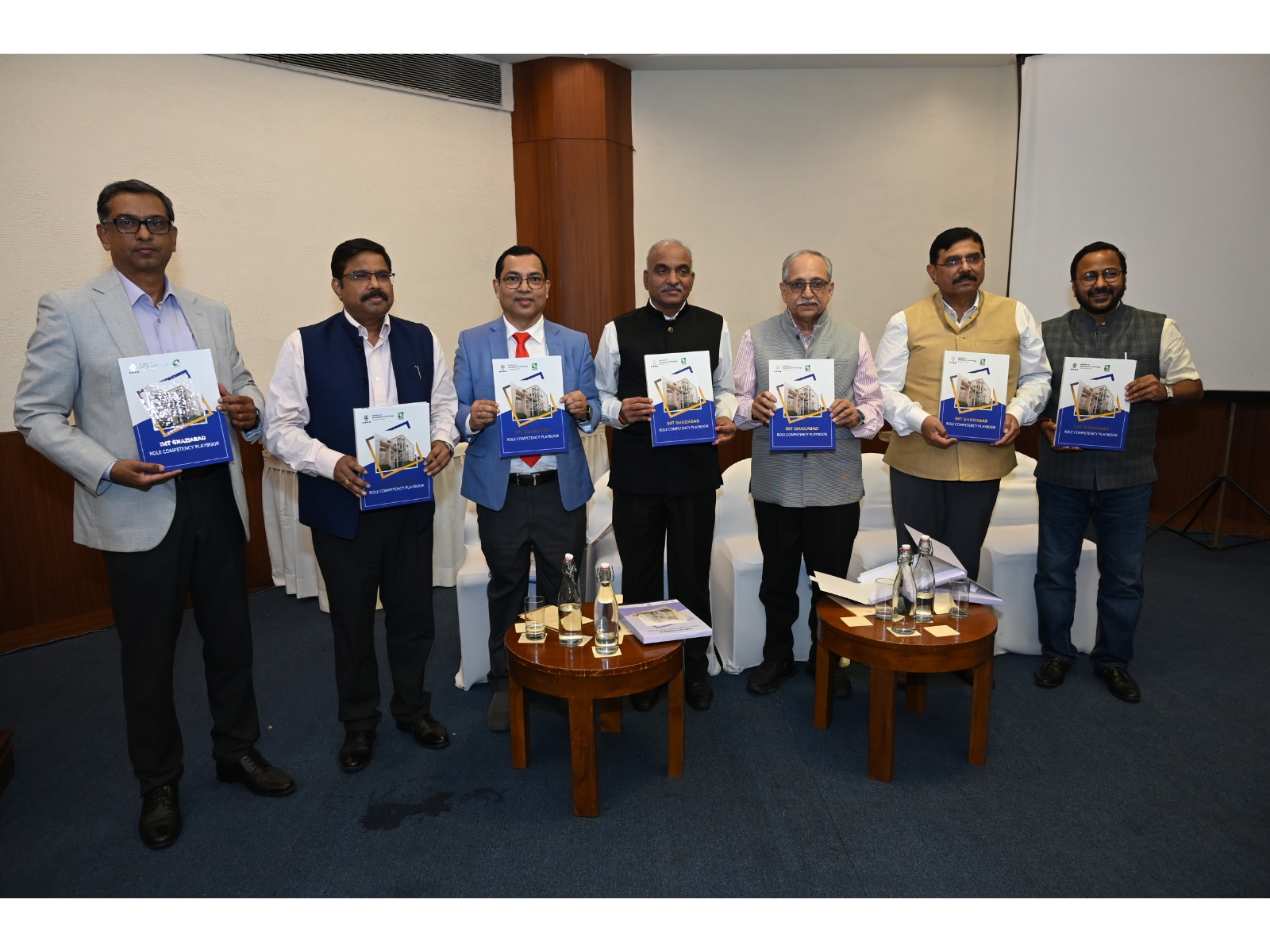
Ghaziabad (Uttar Pradesh) [India], August 21: The Association of Indian Management Schools (AIMS), Northern Region, in association with IMT Ghaziabad, hosted a B-School Leaders' Meet at the India Habitat Centre, New Delhi. The gathering brought together leaders from management institutions to examine how business schools can respond to evolving industry expectations while preserving the broader educational purpose of an MBA.
The deliberations focused on bridging the gap among curriculum, role-specific competencies and workplace expectations. Participants considered how management education can prepare students not only for their first managerial roles, but also for sustained careers in an environment shaped by technological change, new business models and increasing uncertainty. The event also marked the release of IMT Ghaziabad's Role Competency Playbook.
Preparing graduates for known roles--and unknown futures
Prof. Bhimraya Metri, Director, IIM Nagpur, discussed the implications of the National Education Policy 2020 and the changing regulatory environment for business schools. He emphasised that management institutions must balance immediate employability with long-term development, preparing graduates for unfamiliar roles, organisations and career pathways. He also underscored the importance of continuous transformation through unlearning, learning and new learning.
IMT Ghaziabad presents its Role Competency Playbook
Prof. (Dr.) Atish Chattopadhyay, Director, IMT Ghaziabad, presented the institution's Role Competency Playbook and explained the process through which observed employer requirements were translated into role families, competencies, curriculum choices, learning experiences and evidence of readiness.
"Management education must prepare graduates to be role-ready without making them role-bound. At IMT Ghaziabad, our Role Competency Playbook translates evolving managerial roles into competencies, learning experiences and demonstrable evidence of readiness. It develops students across six interconnected layers--conceptual, application, professional, personal, social and global--while preserving intellectual breadth and student agency. Our aim is not merely to prepare students for their first job, but to enable them to adapt, contribute and lead throughout their careers in a changing world."
-- Prof. (Dr.) Atish Chattopadhyay, Director, IMT Ghaziabad
The Playbook begins with a different organising question: instead of asking only what subjects should be taught, it asks what a graduate must be able to do in a target role. The resulting evidence chain connects roles with competencies, knowledge, skills and tools; maps them to courses and developmental experiences; and identifies authentic evidence through which readiness can be demonstrated.
The framework protects the breadth of management education by placing role-specific preparation above--not in place of--strong analytical and managerial foundations. Its six learning layers encompass conceptual understanding; application through cases, simulations and design thinking; professional capability through projects, internships and capstones; personal growth through self-awareness and judgment; social responsibility through stakeholder and societal orientation; and global capability through intercultural exposure.
Faculty members from IMT Ghaziabad described the collaborative process used to translate competency requirements into curriculum, pedagogy and learning experiences. They also highlighted the Individual Development Plan, through which students can connect their aspirations, capability gaps, learning choices, mentoring and evidence of progress.
Addressing the MBA-corporate competency gap
Dr. Amit Agnihotri, Founder - MBAUniverse presented findings from his research on competency gaps in MBA education and discussed how programmes can adopt differentiated pedagogies for different role competencies. His presentation highlighted gaps between roles envisaged by academic institutions and those expected by employers, as well as misalignment between existing curricula and the capabilities required in contemporary business roles.
The discussion drew attention to self-awareness, technical capability, relationship management, social skills, judgment and other behavioural and professional competencies that business schools increasingly need to develop and assess.
A continuing agenda for management education
Participants agreed that role competency frameworks must remain dynamic. They require periodic market scanning, industry validation, curriculum renewal and assessment of authentic performance. At the same time, current job descriptions should inform--but not define--the boundaries of management education.
The IMT Ghaziabad initiative represents an evolving institutional experiment. While the architecture of the Playbook, curriculum mapping and developmental pathway has been established, its impact on competency gains, student agency, equity, role alignment, employer satisfaction and time to effective performance will require continuing validation.
The Leaders' Meet concluded with a shared question for business schools: how can curriculum connect with evolving managerial roles while preserving intellectual breadth, student agency and education's responsibility to prepare graduates for roles that do not yet exist?
About IMT Ghaziabad
Established in 1980 under the aegis of the Lajpat Rai Educational Society, the Institute of Management Technology Ghaziabad is among India's leading management schools. It is accredited by AACSB and the South Asian Quality Assurance System (SAQS). Its PGDM programmes are accredited by the National Board of Accreditation, and its two-year PGDM programmes have MBA equivalence from the Association of Indian Universities. IMT Ghaziabad is ranked No. 1 in India and No. 59 globally in the Financial Times Masters in Finance Ranking 2026, improving seven places globally over the previous year. It was ranked No. 30 in the Management category of the NIRF India Rankings 2025.
IMT Ghaziabad offers AICTE-approved two-year management programmes, programmes for experienced professionals and a Fellow Programme in Management recognised by AIU as equivalent to a PhD. Over more than four decades, the institution has built a global community of over 15,000 alumni serving as business leaders, entrepreneurs, academics, public-service professionals and changemakers.
(ADVERTORIAL DISCLAIMER: The above press release has been provided by PNN. ANI will not be responsible in any way for the content of the same.)
Preparing Managers for Roles That Do Not Yet Exist