New Delhi [India], November 28 (ANI): Ahead of Parliament’s four-day sitting beginning Monday, the Bharatiya Janata Party-led Centre has unveiled a carefully calibrated legislative blueprint—anchored by The Constitution (One Hundred and Thirty-second Amendment) Bill, 2026 and The Delimitation (Second) Bill, 2026—that delivers a uniform 50 per cent increase in seats across every State and Union Territory while safeguarding existing inter-state seat shares until 2051.
Crafted to build broad consensus after the earlier Constitution (131st Amendment) Bill did not pass the Lok Sabha in April 2026, the revised package clears the path to operationalise one-third reservation for women mandated under the 106th Constitutional Amendment Act, 2023. President Droupadi Murmu also cleared a key procedural step on Saturday by recommending Lok Sabha consideration of the Delimitation (Second) Bill under Article 117(3).
Unlike the earlier April draft, the 132nd Amendment Bill applies an even-handed 50 per cent expansion across every State and Union Territory over existing levels, raising the Lok Sabha’s maximum statutory strength from 550 to 850 (comprising up to 815 members from States and 35 from Union Territories), lifting effective House strength from 543 to 815–816 seats, and increasing the maximum strength of State Legislative Assemblies from 500 to 650.
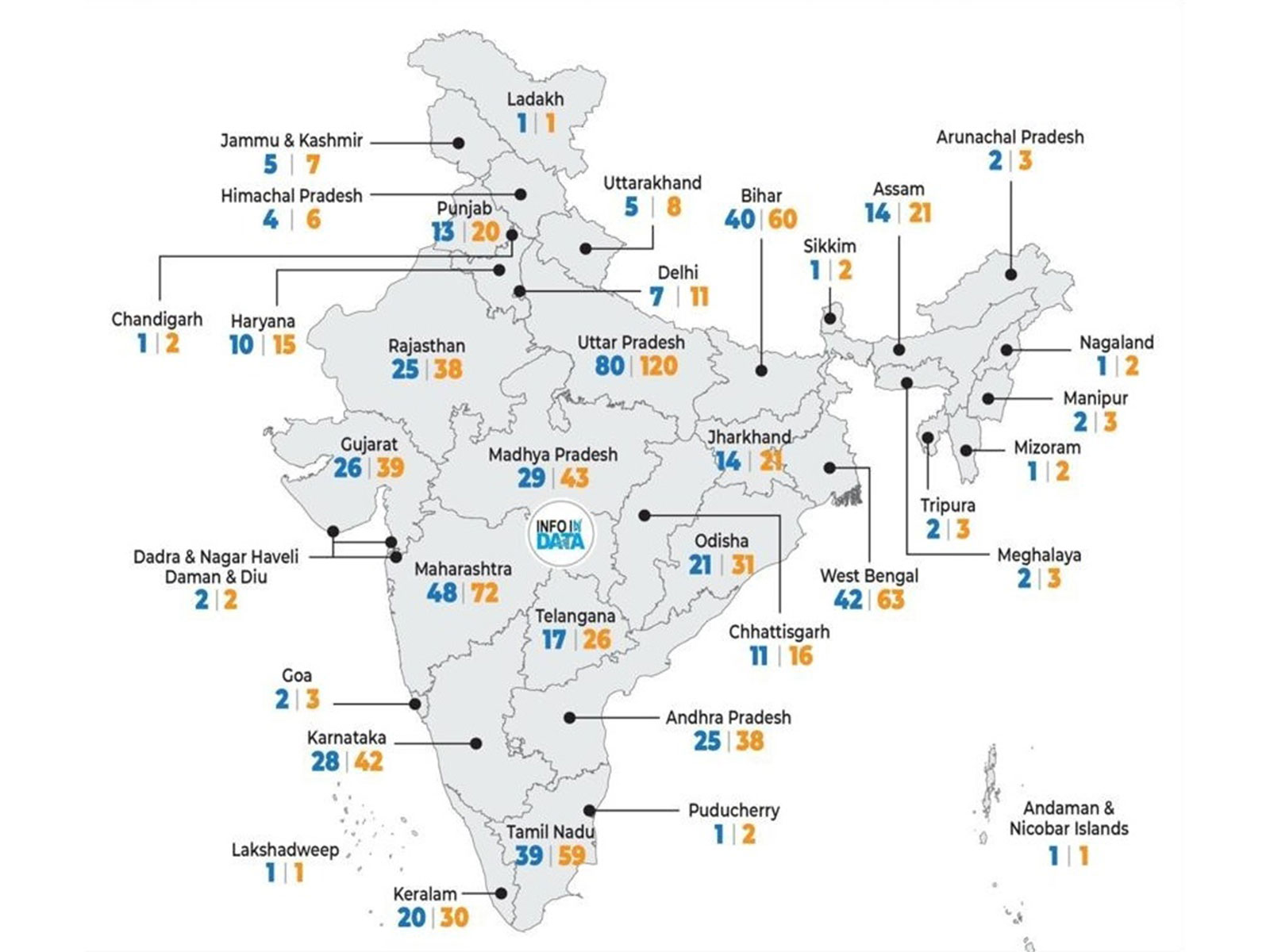
Sharing state-wise projections on X, Union Minister of State (Independent Charge) for Law and Justice Arjun Ram Meghwal emphasised that the 50 per cent expansion from 543 to 816 Lok Sabha seats preserves inter-state balance while giving every region higher representation.
"Every state in the country, whether in the south or the north, has its own importance. As development progresses, it is essential to maintain a balance in every state’s representation," Meghwal said.
Highlighting the numbers for the five southern states, Meghwal noted that their combined strength rises from 129 of 543 Lok Sabha seats (23.76 per cent) to 195 seats in an 816-member House, nudging their combined share slightly up to 23.90 per cent while ensuring every state gains in absolute seat count.
Tamil Nadu rises from 39 seats (7.18 per cent) to 59 seats (7.23 per cent); Andhra Pradesh rises from 25 seats (4.60 per cent) to 38 seats (4.65 per cent); Telangana rises from 17 seats (3.13 per cent) to 26 seats (3.18 per cent); Karnataka rises from 28 to 42 seats, maintaining its 5.15 per cent share and Keralam rises from 20 to 30 seats, maintaining its 3.68 per cent share.
Because the formula applies a uniform 50 per cent multiplier across the board, larger states see larger numerical additions—such as Uttar Pradesh rising from 80 to 120 seats (+40), Maharashtra from 48 to 72 (+24), and West Bengal from 42 to 63 (+21), alongside Bihar (40 to 60) and Tamil Nadu (39 to 59) gaining 20 seats each—while freezing inter-state seat allocations until 2051 prevents abrupt shifts in state-to-state weightage as demographic profiles evolve.
Highlighted by Meghwal’s X projections, gains also map out across major states, smaller states, and Union Territories. Madhya Pradesh rises from 29 to 43 seats, Karnataka from 28 to 42, Gujarat from 26 to 39, Andhra Pradesh and Rajasthan from 25 to 38 each, Odisha and Keralam from 21 to 31 and 20 to 30 respectively, Telangana from 17 to 26, Assam and Jharkhand from 14 to 21 each, Punjab from 13 to 20, Chhattisgarh from 11 to 16, Haryana from 10 to 15, Delhi from 7 to 11, Uttarakhand from 5 to 8, Jammu and Kashmir from 5 to 7, and Himachal Pradesh from 4 to 6.
While smaller states & UTs like Arunachal Pradesh, Goa, Manipur, Meghalaya, and Tripura each move from 2 to 3 seats; Chandigarh, Mizoram, Nagaland, Puducherry, and Sikkim each rise from 1 to 2 seats; Dadra and Nagar Haveli and Daman and Diu stay at 2 seats; and Andaman and Nicobar Islands, Ladakh, and Lakshadweep remain at 1 seat each.
Beyond seat expansion, the Bill brings the Union Territory of Jammu and Kashmir alongside Delhi and Puducherry within the definition of "State" for presidential elections under Articles 54 and 55, uses the latest published census figures available on commencement for redrawing internal constituency boundaries, and operationalises one-third reservation for women—including within Scheduled Caste and Scheduled Tribe constituencies—for an initial 15-year period from the commencement of the 106th Amendment.
The Delimitation Commission framework also balances practical ground parameters—such as geographical compactness, physical features, existing administrative units, communication facilities, and public convenience—alongside structured rotation of reserved seats and a three-member Commission chaired by a sitting or former Supreme Court judge appointed by the Central Government.
Politically, the NDA’s floor prospects have strengthened ahead of Monday’s Lok Sabha reconvening (followed by the Rajya Sabha on December 2), with indications of backing from the DMK and NCP–Sharadchandra Pawar lifting the ruling bloc’s estimated Lok Sabha tally from around 320 to roughly 350 MPs.
With five vacancies in the 543-member Lok Sabha leaving 538 sitting members—meaning 359 votes would represent a two-thirds threshold if all 538 participate—the alliance stands within 10 votes of that benchmark even before factoring in attendance and abstentions under Article 368’s requirement of a majority of total membership and at least two-thirds of members present and voting.
Indications of backing from the DMK and NCP-Sharadchandra Pawar have lifted the NDA's estimated Lok Sabha tally from around 320 to roughly 350 MPs.The ruling NDA's estimated strength stands at around 320 MPs. Both the DMK, with 22 MPs, and the NCP-Sharadchandra Pawar, with 8 MPs, have indicated support for the Centre's revised delimitation proposal, which provides for a uniform 50% increase in seats across states while preserving their relative representation. Adding those 30 MPs takes the projected tally to around 350.
In practice, the Speaker does not vote in the first instance, only casting a deciding vote in the event of a tie. Only 539 members, including the Speaker, can attend, making 538 members eligible to vote and lowering the full-attendance two-thirds mark to 359.
The two-thirds requirement applies only to those present and voting; absences or abstentions reduce the denominator and lower the exact number of votes needed to pass the bill.
Under Article 368, a constitutional amendment requires a majority of total membership and at least two-thirds of members present and voting, meaning attendance and abstentions affect the final threshold. (ANI)
Flat 50% seat hike, 2051 freeze and Women’s quota: How BJP’s balanced blueprint protects states