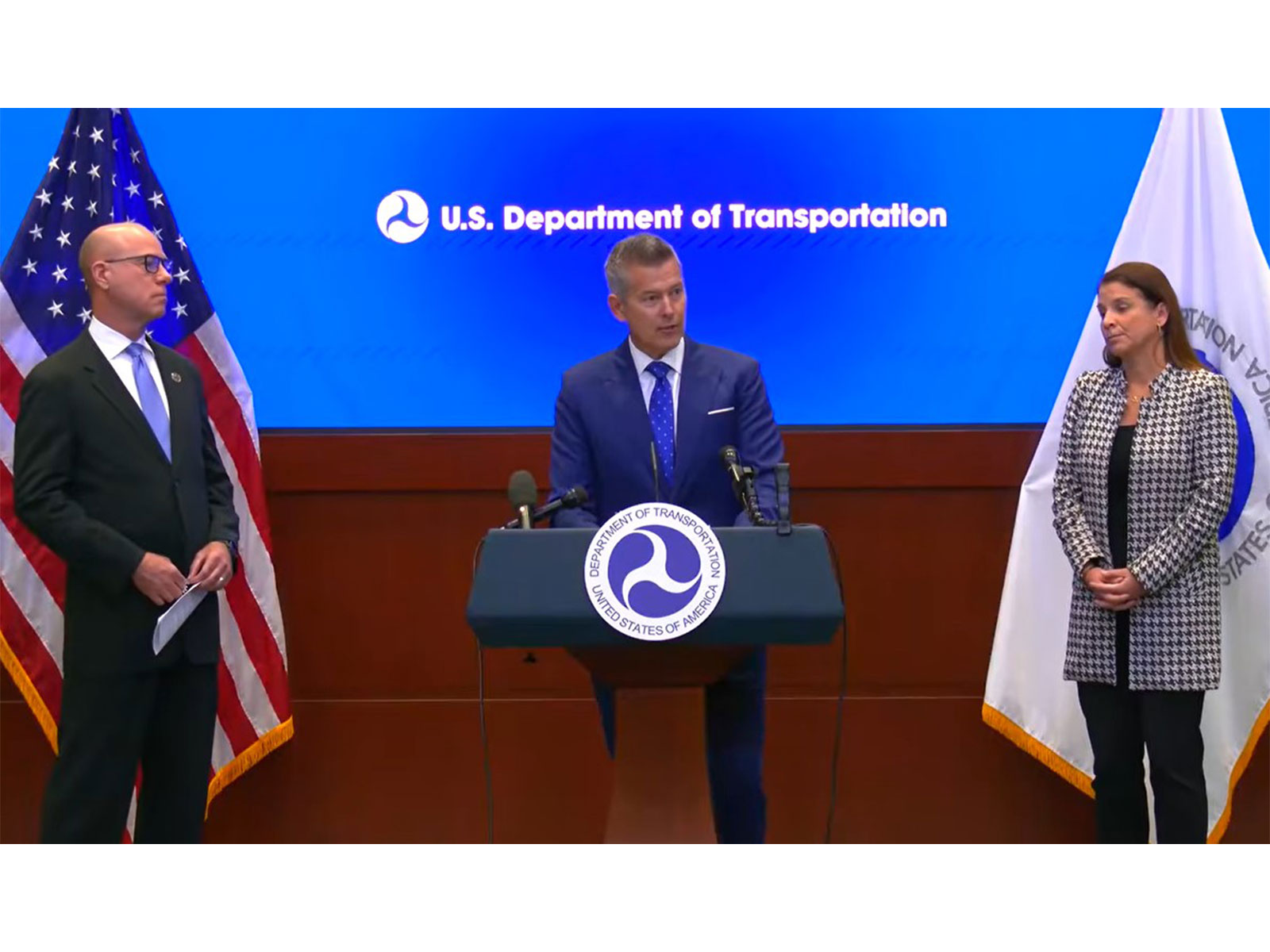
Washington, DC [US], November 14 (ANI): US Transportation Secretary Sean Duffy said Saturday (local time) that investigators are probing whether contractor "incompetence" or a faulty router triggered the massive air traffic control system outage that forced a rare nationwide ground stop on Friday, even as flight disruptions persisted into the weekend while Federal Aviation Administration (FAA) Administrator Bryan Bedford assured travellers that "the worst is behind us."
Speaking at a Department of Transportation news conference, Duffy ruled out a cyberattack as the cause of the four-hour ground stop, explaining that the failure occurred during a network upgrade from copper to fibre wiring when a router being replaced began flooding other routers across the system.
"So what we're working to determine was whether we had incompetence, meaning was it user error, installer error from L3Harris, or did they install a faulty router? We haven't determined what the fault was," Duffy told reporters. "Was it the router or were they not doing great work for us at L3Harris? Either through contractor error or a faulty piece of equipment, that router that was being replaced as we switch from copper to fibre started flooding other routers in our air traffic control system."
Duffy detailed how the malfunctioning hardware overwhelmed air traffic control communications and radar feeds before officials isolated the remote site and brought systems back online.
"We had over 1,000 connection attempts every four to five seconds, and what that did was give us issues with our communication with aeroplanes, and it also caused some disruption with our radar feeds," he said, adding that travellers' safety remains "paramount."
Addressing speculation over foreign interference, Duffy stated: "A lot of questions came in yesterday: was this a cyber attack? Did some foreign nation attack this network? And the answer to that is we don’t believe so." He added, "Once we were able to isolate the work that was being done at this remote location, all of our systems came back online. This was an FAA system that didn’t meet the moment."
While airspace has reopened, ripple effects continued to snarl air travel across the country on Saturday. FAA Administrator Bryan Bedford projected that roughly 4,000 to 5,000 flights out of the 41,000 scheduled for Saturday would be cancelled as airlines work to reposition displaced planes and crews.
"As we went into Friday, we had 50,000 flights scheduled to operate. When we went into the ground stop at approximately 3:45 p.m. East Coast time yesterday, we had completed about 30,000 of those flights, either on the ground or in the air," Bedford explained. Although officials recovered 8,000 of the remaining 20,000 flights, 12,000 were lost.
"We have crews and aircraft that are out of position for 12,000 flights that were lost," Bedford said. "These crews, pilots and flight attendants need to get to their points of reconnection with their schedules."
However, Bedford expressed optimism that normal operations would resume by the end of Sunday. "That will set us up for a full recovery tomorrow," he said. "I do think the worst is behind us."
Bedford offered a "sincere apology to the American travelling public" for the travel chaos, emphasising that the ground stop was ordered "out of an abundance of caution" after the system "started to exhibit some instability."
"I’m sorry that we put you through this, but we did it for the right reasons," Bedford said, praising air traffic controllers, maintenance technicians, airlines, and airports that worked overnight to mitigate the fallout.
Echoing Duffy, Bedford confirmed the outage stemmed from an equipment issue rather than foul play, stating, "We see zero evidence of anything nefarious, and zero evidence of anything AI-related." He noted that the FAA is still determining whether the failure resulted from "faulty installation," "faulty configuration," or defective router hardware, and promised to release a root cause analysis once completed.
Bedford also sought to reassure flyers that the US airspace remains secure, pointing to multi-layered redundancies across ground teams, pilots, and controllers.
"The number one mission at FAA and our Air Traffic Organisation is to fly people to their destination safely, and we will, and err on the side of safety, we will keep airplanes on the ground unless we are 100% confident we've got the stability and the resiliency to operate safely," he said. "So I'm confident, very, very confident that the system is operating as safe today as it was two weeks ago."
Duffy used the breakdown to renew his push for increased congressional funding to modernise ageing aviation infrastructure, noting that Congress had previously provided a "partial payment" of $12.5 billion.
"I think this is a sign for them to lean in," Duffy said. "Let’s make the investments and look forward to a brighter future in aviation, a safer future, a more efficient future in aviation."
Earlier in the day, Duffy assured revival of operations back to normal while noting that some delays and cancellations would continue due to rescheduling of flights by carriers repositioning of aircraft and crews.
"Operations are slowly returning to normal this morning. Planes are pushing back, taxiing, and taking off, and it is safe to fly. We are in close coordination with the airlines to support the ongoing recovery. You will continue to see some delays and cancellations as carriers reschedule flights and reposition aircraft/crews where they are needed most. Our top priority right now is making sure travelers get home safely to their families as quickly as possible. To our air traffic controllers, pilots, and flight crews who are working around the clock: the nation thanks you for your professionalism and dedication to the flying public," he wrote in a post on X.
Meanwhile, the disruption sparked sharp political backlash, with Democratic New York Governor Kathy Hochul calling on Saturday morning for Duffy to resign or be fired by President Donald Trump, while urging Congress to launch a full investigation to "ensure it never happens again."
"From chronic air traffic controller shortages to repeated communications breakdowns, serious lapses in our aviation system have become a pattern on Sean Duffy’s watch," Hochul said in a statement. "Through it all, he’s been more focused on starring in his own reality show than addressing the crisis at his agency."
The remarks came after the FAA lifted the nationwide ground stop imposed across US airports following a telecommunications outage that disrupted air traffic control operations, triggering thousands of flight delays and cancellations.
In a briefing held on Friday (local time), Duffy had earlier attributed the technical failure to ageing telecommunications infrastructure, explaining that radar and communication systems at air traffic control centres and Terminal Radar Approach Control (TRACON) facilities experienced instability at approximately 3:36 pm local time.
He said air traffic controllers began receiving inconsistent radar data and communication signals from aircraft, prompting authorities to activate established safety procedures and halt flights as a precaution.
Duffy said more than 3,500 aircraft were airborne when the ground stop was issued, adding that authorities coordinated their safe landing. He also clarified that critical operations, including medical evacuation flights, cargo movements carrying essential medicines and law enforcement activities, were allowed to continue.
According to Duffy, the country's legacy telecommunications equipment, which operates on an analogue system, became overloaded with data, resulting in inconsistencies in information transmitted through its switches and routers. Newer Internet Protocol (IP) switches installed under the Trump administration continued functioning during the disruption, he said.
The Transportation Secretary renewed the administration's appeal to Congress for bipartisan funding to build an entirely new air traffic control system rather than relying on incremental repairs.
Meanwhile, the FAA confirmed that all flights had been accounted for, while international arrivals were handled on a case-by-case basis.
According to flight-tracking platform FlightAware, approximately 7,000 flights were delayed or cancelled following the disruption.
The outage also prompted airlines to issue travel advisories. Air India warned of possible consequential disruptions to its flights to and from the United States, advising passengers to check their flight status before travelling to airports. (ANI)
"Incompetence or faulty router?": Transport Secy Sean Duffy says US probes ATC meltdown as disruptions drag on; FAA says 'worst is behind us'