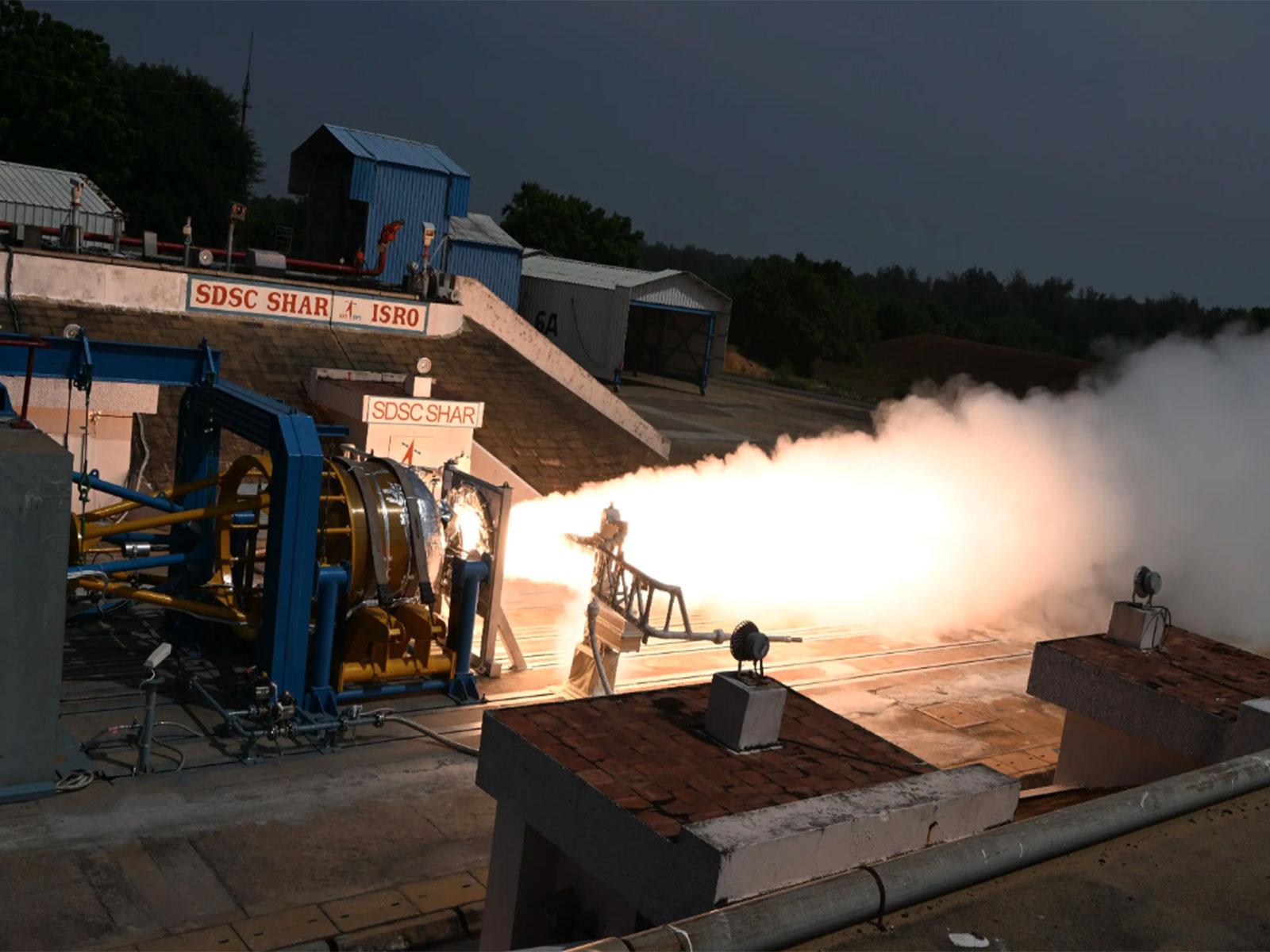
Sriharikota (Andhra Pradesh) [India], November 12 (ANI): The Indian Space Research Organisation (ISRO) on Thursday successfully conducted a ground static test of the third stage (PS3) of its Polar Satellite Launch Vehicle (PSLV) at the Static Test Facility of the Satish Dhawan Space Centre in Sriharikota.
The test follows a comprehensive review and strengthening of the stage's configuration after anomalies were observed during the PSLV-C61/EOS-09 and PSLV-C62/EOS-N1 missions.
According to ISRO, the PS3 stage configuration was comprehensively revisited following the anomalies, with particular attention to design margins, raw material acceptance criteria, assembly procedures and quality checks.
The configuration was strengthened, with essential improvements made to the nozzle design to enhance design margins. Updated procedures were also introduced for raw material acceptance, assembly and quality checks.
ISRO further strengthened the mechanical interfaces and incorporated redundancy in the sealing systems. The adequacy of the design margins was also verified as part of the review.
In addition, updated assembly procedures and Non-Destructive Testing (NDT) measures were implemented during various phases of integration and transportation.
Following these modifications, the new version of the PS3 solid motor stage was realised and successfully tested on November 12.
ISRO said that based on a detailed analysis and review of the test data, further tests are planned.
Meanwhile, the Indian Space Research Organisation (ISRO) on October 31 launched its next-generation navigation satellite NVS-03 aboard the GSLV-F18 rocket from the Satish Dhawan Space Centre in Sriharikota.
The satellite is the third in ISRO's next-generation navigation satellite series, envisaged to ensure continuity of navigation services under the Indian Regional Navigation Satellite System (IRNSS).
NVS-03 carries an indigenous atomic clock, along with procured atomic clocks. It also incorporates the L1 navigation signal in addition to the existing L5 and S-band signals, expanding NavIC's capabilities. The system is designed to provide coverage over India's landmass and an area extending 1,500 km beyond its geopolitical boundary, according to ISRO.
The launch is expected to strengthen India's indigenous navigation system, NavIC, and enhance the country's independent satellite-based navigation capabilities. (ANI)
ISRO successfully conducts ground static test of PSLV's third stage at Sriharikota