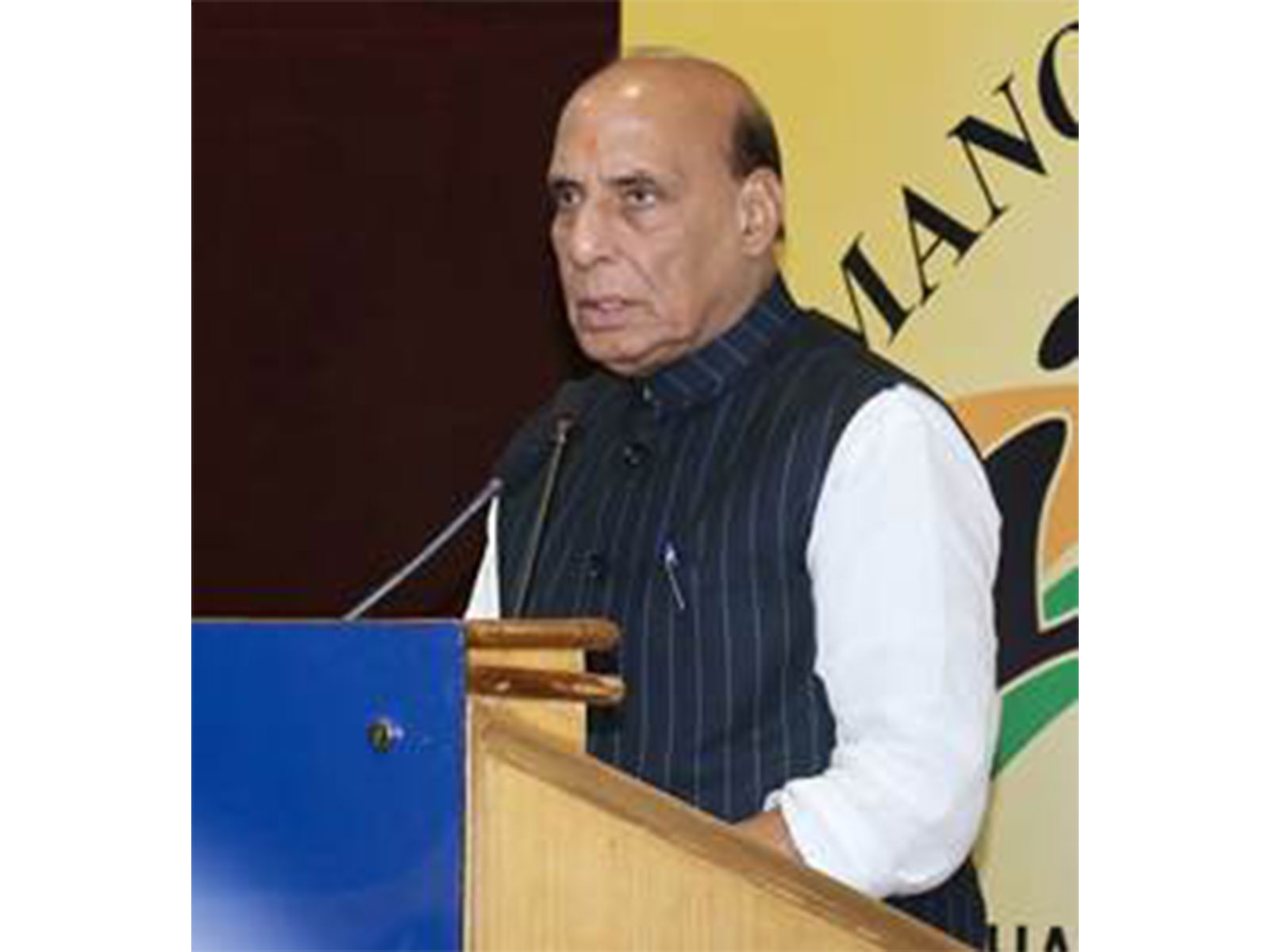
New Delhi [India], November 4 (ANI): Defence Minister Rajnath Singh on Tuesday said military preparedness in the 21st century is closely linked to technological and industrial capabilities, emphasising the need for indigenous production of critical equipment and technologies and the capacity to sustain them independently.
Addressing the third edition of the Delhi Defence Dialogue at Manohar Parrikar Institute for Defence Studies and Analyses (MP-IDSA) on November 3, he emphasised that ‘Aatmanirbharta’ must be viewed as a quest for technological sovereignty, as self-reliance means ensuring that the nation's critical defence requirements are not held hostage to external dependencies. True self-reliance is achieved by possessing the knowledge to design a defence platform, the technology to manufacture it, intellectual property to improve it and the capability to sustain it throughout its lifecycle, he said.
Sharing his insights on the theme of this year's Dialogue, ‘Defence Reforms, Aatmanirbharta, Collaborations and Exports’, the Defence Minister described the four elements as interconnected dimensions of India's objective to become Viksit Bharat by 2047.
He stated that reforms must create an enabling institutional environment, Aatmanirbharta must strengthen indigenous technological capabilities, collaborations must accelerate access to advanced technologies and facilitate co-development, and exports must provide the scale, competitiveness and global partnerships required for a sustainable industrial ecosystem. These four elements are mutually reinforcing pillars of India's quest for strategic autonomy, he said.
Rajnath Singh underlined that reforms represent the nation's willingness to change, Aatmanirbharta symbolises its determination to create, collaborations reflect its confidence to partner with the world, and exports demonstrate its readiness to compete globally. He emphasised that these four elements must progress together, as self-reliance without reforms, international collaborations and exports would limit India's technological horizons, industrial scale and global competitiveness.
The Defence Minister pointed out that recent conflicts across the world have demonstrated a fundamental transformation in the character of warfare, with battlefields extending beyond land, sea and air into space, cyberspace and the digital domain. He stated that the distinction between conventional and unconventional warfare is increasingly blurring, while relatively inexpensive drones and autonomous systems are challenging sophisticated and costly military platforms. The ability to innovate rapidly, manufacture at scale and replenish capabilities has become as important as possessing advanced weapon systems, he added.
Highlighting that technological and manufacturing capabilities require an enabling institutional environment, progressive policies and responsive processes, Rajnath Singh outlined the initiatives undertaken over the last decade to strengthen India's domestic defence industrial base. These include the establishment of Defence Industrial Corridors and the corporatisation of the erstwhile Ordnance Factory Board into seven Defence Public Sector Undertakings (DPSUs), aimed at enhancing autonomy, efficiency and competitiveness in defence manufacturing.
The Defence Minister reiterated the Government's commitment to encouraging greater private sector participation in the development and manufacturing of advanced defence platforms and systems.
“Opportunities for private participation in programmes such as the Advanced Medium Combat Aircraft, propulsion systems, ATAGS, artillery ammunition and shipbuilding will accelerate indigenous development, expand manufacturing capacity and strengthen India's position in the global defence market. These initiatives are creating opportunities for wider participation by private industry, MSMEs, start-ups and academia,” he said.
Rajnath Singh highlighted that 2025 was observed as the Year of Reforms in the Ministry of Defence, with a focus on jointness, integration, emerging technologies, innovation and strengthening the domestic defence industrial ecosystem. He said that reforms initiated across policies, institutional structures, technology development, acquisition procedures and ease of doing business are yielding positive results, with defence production reaching a record level of approximately Rs 1.78 lakh crore in FY 2025-26 and defence exports rising to Rs 38,424 crore. Indian defence products are now reaching more than 80 countries, reflecting the growing contribution of public sector enterprises, private industry, MSMEs and start-ups, he added.
The Defence Minister described defence exports as a crucial dimension of India's self-reliance agenda, stating that exports reflect the maturity of the domestic industrial ecosystem, the competitiveness of indigenous technologies and the confidence of international partners in India's capabilities. He attributed the growth to sustained policy liberalisation, simplification and standardisation, which have enabled Indian manufacturers, particularly MSMEs, to respond more effectively to international opportunities.
Rajnath Singh called for expanding the scope of defence exports to include maintenance, repair, training, logistics and technology cooperation, stating that every successful export should become the foundation of an enduring strategic partnership. He reiterated the Government's resolve to achieve the targets of Rs 3 lakh crore in defence production and Rs 50,000 crore in defence exports by 2029. The domestic defence industry must expand manufacturing capacity, improve quality and strengthen global competitiveness to achieve these objectives, he said.
The Defence Minister emphasised that the Defence Forces must remain important stakeholders in the R&D process, as their operational experience and understanding of the battlefield are invaluable in informing research priorities and assessing the relevance of emerging technologies. At the same time, he stressed the need to look beyond the immediate requirements of the end-user in the research process. He observed that research driven too closely by immediate operational perceptions could end up addressing only recognised problems, rather than exploring possibilities that may not yet have been imagined. R&D must have the freedom to question established assumptions, pursue unconventional ideas and discover technologies whose applications may not be immediately apparent, he said.
Rajnath Singh called for striking the right balance by allowing operational requirements to inform research while preserving the independence and intellectual space necessary for innovation. He underscored the importance of encouraging experimentation and ensuring that successful innovations move beyond laboratories and prototypes towards production and operational induction. The objective must be to create an ecosystem in which innovation is encouraged, investment is sustained and successful ideas are translated into capabilities, he said.
On international defence collaborations, the Defence Minister asserted that India's pursuit of self-reliance does not signify a retreat from the world; it symbolises a confident and technologically capable India better positioned to engage with international partners. He noted that while traditional partnerships based on procurement, licensed manufacturing and transfer of technology have contributed to India's industrial capabilities, future requirements call for a more ambitious approach based on co-development, co-production and shared innovation.
“Such partnerships should ensure meaningful Indian participation in design and development, access to critical technologies, appropriate sharing of intellectual property and opportunities for Indian companies to participate in global supply chains. Our large domestic market, expanding industrial base and strong pool of scientific and engineering talent offer significant opportunities for international companies to partner with Indian industry,” said Rajnath Singh.
Concluding his address, the Defence Minister called for a collective commitment from the Defence Forces, civil servants, scientists, industry, academia and international partners to realise India's defence ambitions. He stated that the country's aspiration must be to move beyond procuring defence technologies towards creating them, beyond manufacturing for domestic requirements towards competing in global markets, and beyond participating in international defence partnerships towards contributing meaningfully to shaping the future of global defence technology. He expressed confidence that the deliberations at the Delhi Defence Dialogue would generate valuable ideas and actionable recommendations towards achieving this vision.
In his welcome remarks, Director General, MP-IDSA, Ambassador Sujan R Chinoy highlighted that the Delhi Defence Dialogue 2026 would provide a platform for exchanging perspectives on defence reforms, indigenous capabilities, international collaborations and defence exports. He also referred to the two preparatory roundtables organised by MP-IDSA on propulsion systems and defence exports, as well as the inaugural ASEAN-India Defence Think Tank Forum, which further strengthened the Institute's international engagement.
CISC Air Marshal Tejinder Singh, Additional Secretary Dipti Mohil Chawla, other senior serving & retired officials, and foreign dignitaries were present on the occasion
The two-day dialogue, organised by MP-IDSA on November 3 & 4, 2026, brings together policymakers, representatives of the Defence Forces, defence industry, academia, think tanks and strategic experts from India and abroad to deliberate on India's evolving defence priorities and opportunities for international cooperation.
The deliberations are focused on generating actionable policy recommendations to strengthen India's defence preparedness, promote indigenous technological capabilities and expand opportunities for international defence cooperation. The dialogue seeks to facilitate greater engagement among the Government, industry, original equipment manufacturers (OEMs), MSMEs, start-ups and research institutions. The outcomes are expected to provide valuable inputs for policy formulation and contribute to advancing India's strategic vision of a self-reliant and technologically advanced defence ecosystem. (ANI)
“Self-reliance is not a retreat from the world; it positions India better for global collaborations”: Defence Minister Rajnath Singh