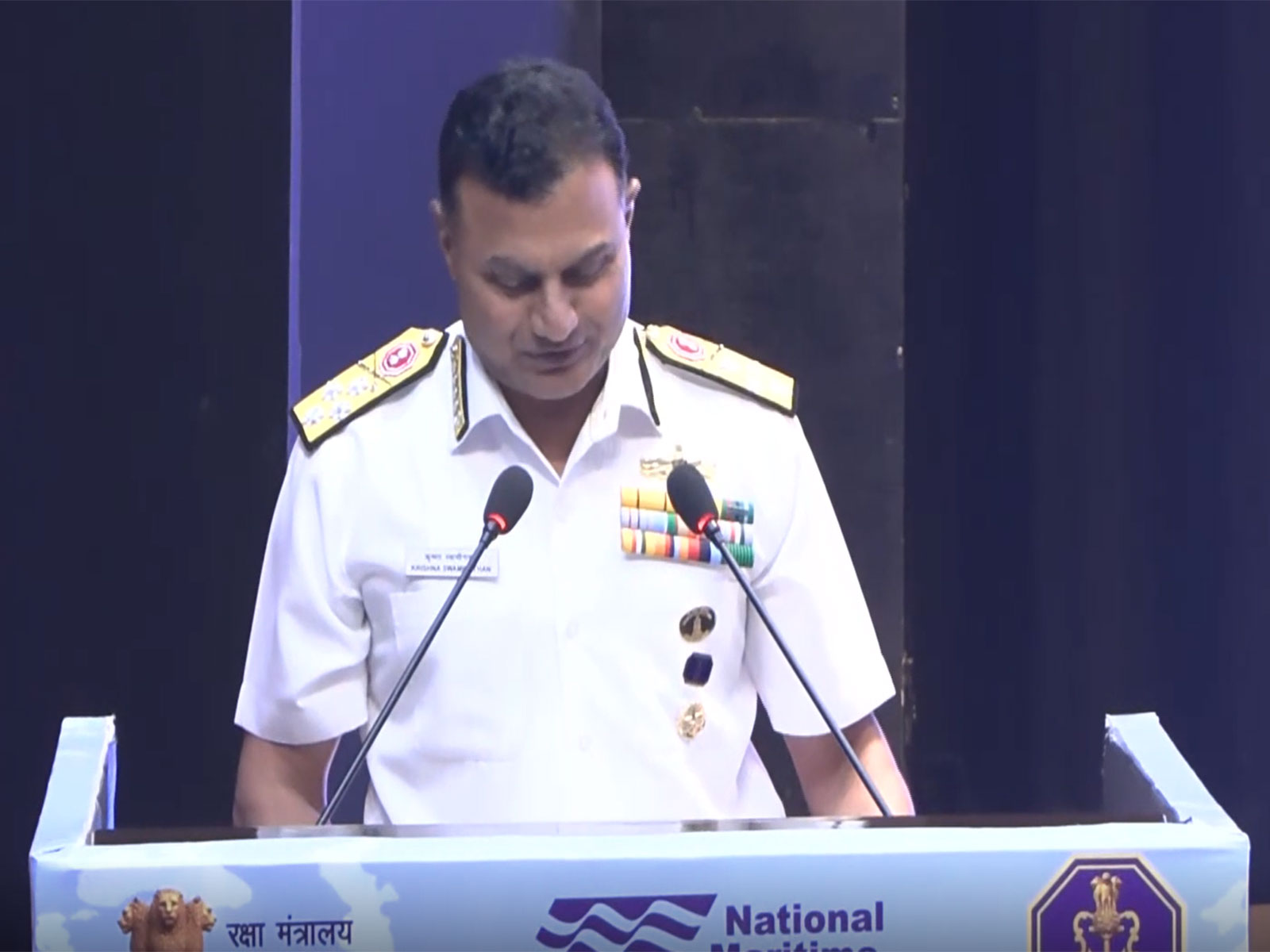
New Delhi [India], November 4 (ANI): Navy Chief Admiral Krishna Swaminathan on Wednesday highlighted the need for greater investment in ocean sciences and regional cooperation, citing warming oceans, rising sea levels, erratic rainfall patterns, intense cyclones and marine pollution.
Addressing the Indo-Pacific Regional Dialogue 2026, Admiral Swaminathan said several nations were facing the effects of El Nino, increasing erratic rainfall patterns and growing risks of intense cyclones. He also pointed out that marine pollution did not remain confined to the waters in which it originated.
“The oceans are warming, and sea levels are rising. Several nations are facing the effects of El Niño, increasing erratic rainfall patterns and growing risks of intense cyclones. Marine pollution also does not remain confined to the waters in which it originates. In an era like this, we find that investment in ocean sciences remains low,” he said.
Highlighting the disparity in global research investment, the Navy Chief said the annual median share of national research budgets allocated to ocean sciences remained below one per cent, with only 10 countries operating two-thirds of the world’s research vessels.
“The annual median share of national research budgets allocated to ocean sciences remains below 1%, with only 10 countries operating two-thirds of the world's research vessels. The disparity in research effort is also significant. The number of researchers per million inhabitants varies from fewer than a hundred in some regions to over four thousand in others,” he said.
He said the uneven distribution of scientific capabilities and capacity globally reinforced the need for greater collaboration in the field.
“This highlights the uneven distribution of scientific capability and capacity globally and reinforces the urgent need for greater collaboration in this field,” he added.
On technology transfer, Admiral Swaminathan said the emphasis often remained on equipment acquisition rather than capability development, leaving recipient nations dependent on external partners for operation, maintenance and upgrades.
“Even in technology transfer, the emphasis often remains on equipment acquisition rather than capability development, which leaves recipient nations dependent on external partners for operation, maintenance, and upgrades,” Swaminathan said.
He further called for moving beyond the academic concept of STEM to a broader STEAM framework, incorporating art and encouraging interdisciplinary thinking, including elements of the humanities such as design, creativity and innovation in problem-solving.
“We need to integrate life sciences and social sciences with physical sciences and in viewing the seas move from the academic concept of STEM to a broader form of framework of STEAM that not only incorporates art into its calculus but also encourages interdisciplinary thinking and includes elements of the humanities such as design, creativity, and innovation in our effort towards problem solving,” he said.
“This wider perspective is essential to address the complex maritime challenges of our times and translate shared interests into practical, people-oriented outcomes that enable us to effectively further the vision of the IPOI,” he added. (ANI)
“Investment in ocean sciences remains low”: Navy Chief Admiral Krishna Swaminathan calls for greater regional cooperation